
FTC Fake Review Rules: What's Illegal in 2026 (and What Your Business Needs to Know) |
The FTC's fake review rule carries substantial financial penalties for violations, while Google's separate review policies impose additional restrictions on businesses. Here's how to protect your business, stay compliant, and build an authentic online reputation. |
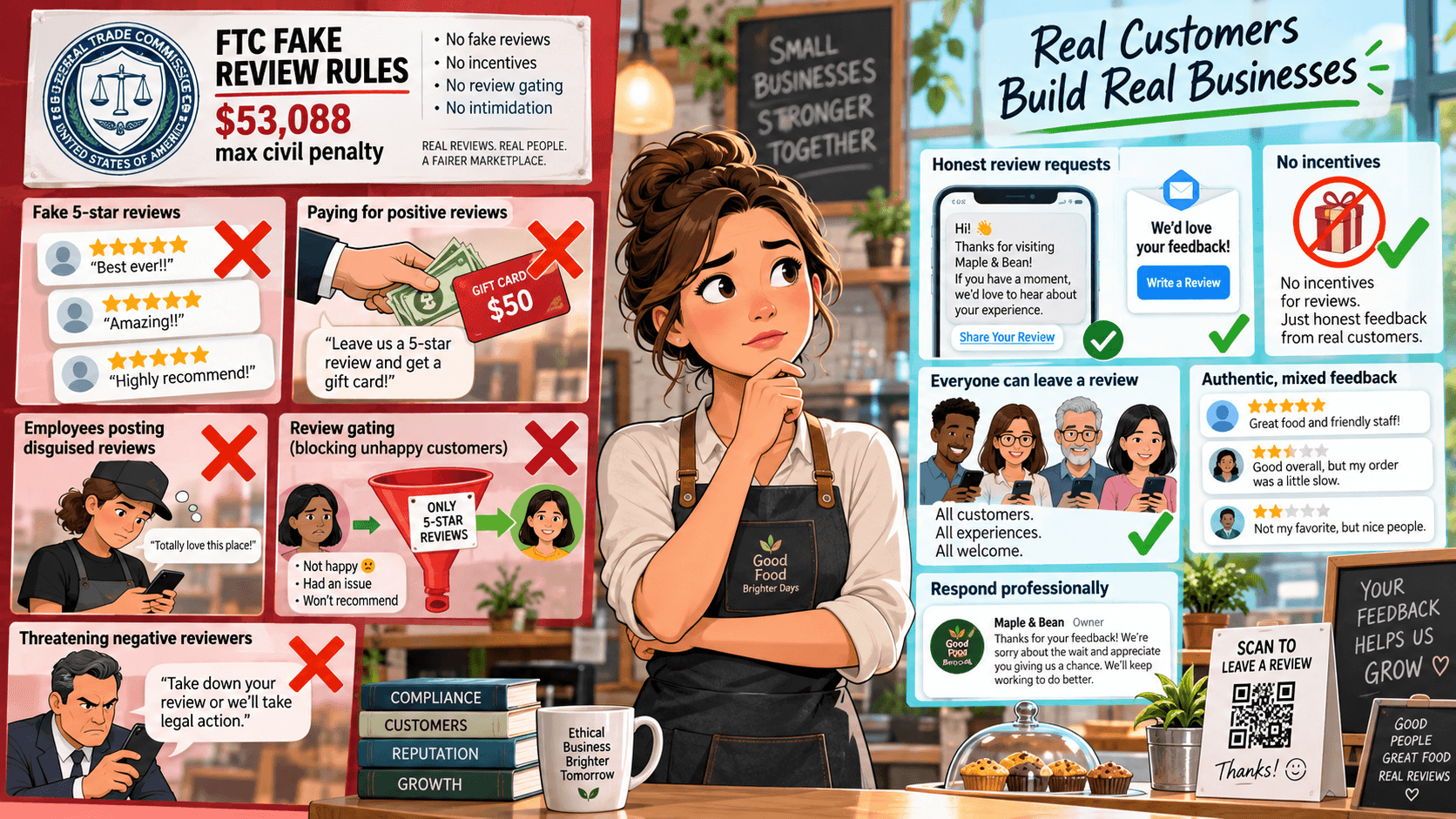
Online reviews are essential to building consumer trust, but the rules governing how businesses collect and manage them have become increasingly important.
On October 21, 2024, the Federal Trade Commission's Consumer Reviews and Testimonials Rule took effect, establishing specific prohibitions against fake reviews, deceptive testimonials, undisclosed insider reviews, and other misleading practices.
Google also enforces its own policies to prevent businesses from manipulating customer ratings or misleading potential customers. These platform policies sometimes go further than federal law.
Understanding the difference is essential. Violating Google's policies can result in removed reviews and restrictions on your Business Profile, while violating federal consumer-protection law can expose businesses to legal action and substantial financial penalties.
Here's what every business owner needs to know about collecting and managing customer reviews in 2026.
What's Prohibited Under Federal Law
1. Fake and Fabricated Reviews
Creating or purchasing fake customer reviews is prohibited under the FTC's rule. This includes reviews written by people who never used a product or service, reviews that misrepresent the reviewer's actual experience, and fabricated testimonials generated using artificial intelligence.
Businesses must not:
AI can assist businesses with drafting review responses and organizing customer feedback. However, using AI to invent customer experiences or create fake testimonials violates the FTC's rule.
2. Incentives for Positive or Negative Reviews
The FTC prohibits businesses from offering compensation or incentives conditioned on customers writing reviews expressing a particular positive or negative sentiment.
For example, offering customers a discount specifically for posting a five-star review violates the rule. The same prohibition applies to rewarding customers for posting negative reviews about competitors.
Federal law does not categorically prohibit every incentive for an honest review. However, incentives must not be conditioned on sentiment, and material incentives generally require appropriate disclosure.
Google's policies are stricter: businesses cannot offer payments, discounts, free products, or other incentives in exchange for posting, changing, or removing Google reviews, regardless of the rating.
3. Undisclosed Insider Reviews
Reviews from employees, company officers, managers, and family members can mislead consumers when important relationships are concealed.
The FTC's rule establishes requirements for certain insider reviews and testimonials, including clear disclosure of material connections between reviewers and businesses.
Even when a relationship is disclosed, a review must accurately represent a genuine experience.
Google separately prohibits reviews affected by conflicts of interest, which can include employment, business relationships, and family connections.
Businesses should avoid asking employees, relatives, or contractors to post Google reviews about their own businesses.
4. Deceptive Review Suppression
Businesses cannot use intimidation, certain unfounded legal threats, or false accusations to prevent consumers from sharing truthful negative feedback. The FTC's rule also prohibits businesses from misrepresenting that displayed reviews represent all or most submitted reviews when negative reviews have been suppressed based on their ratings or sentiment. Businesses may address legitimate complaints and report reviews that violate platform policies, but they should not manipulate the public's perception by deceptively hiding unfavorable customer experiences.
Google's Review Policies: Additional Restrictions
5. Review Gating and Selective Solicitation
Review gating occurs when businesses encourage satisfied customers to leave public reviews while directing dissatisfied customers toward private feedback channels.
Google prohibits selectively soliciting positive reviews or discouraging negative reviews.
The FTC's review rule does not expressly ban every instance of selectively requesting reviews, although misleading review-collection practices may violate broader federal consumer-protection law.
Businesses should provide all customers with an equal opportunity to submit honest public reviews, regardless of their satisfaction level.
Private surveys can still help resolve complaints, but they should not become barriers preventing dissatisfied customers from accessing public review links.
6. Review Kiosks and Shared Devices
The FTC's review rule does not specifically prohibit using shared devices or in-store review kiosks.
However, Google's policies prohibit fake engagement, including the use of emulators, modified operating systems, or device-tampering techniques to manipulate review activity.
Businesses should avoid practices that create misleading review patterns or undermine the authenticity of customer feedback.
Instead of relying on shared devices, provide customers with a direct review link or QR code they can access using their own phones.
Google permits businesses to display review QR codes in their stores.
7. Employee Review Quotas and Scripted Content
Google prohibits businesses from requiring staff to solicit a specific number of customer reviews. It also prohibits merchants from requesting that reviews contain specific content, including the names of employees.
These restrictions are part of Google's platform policies, not separate provisions making every employee review target a federal offense.
Businesses should train staff to invite customers to share genuine feedback without dictating ratings, requiring specific wording, or pressuring customers to mention individual employees.
8. Pressuring Customers on Business Premises
Google prohibits businesses from requiring or pressuring customers to submit reviews while on the premises.
However, simply inviting customers to review a business during their visit is not automatically prohibited.
Businesses may display QR codes, provide review links, and verbally invite customers to share their experiences.
Customers should always remain free to decide whether, when, and how to leave a review.
FTC and Google Penalties in 2026FTC Civil Penalties
Maximum FTC civil penalty per violation $53,088Applicable maximum as of September 2026. Courts may impose civil penalties for knowing violations of the FTC's Consumer Reviews and Testimonials Rule. Penalties are not automatic.
Multiple violations can expose businesses to substantial financial penalties and legal action. Advertising agencies and reputation management companies can also face liability for participating in prohibited conduct.
Google Business Profile Restrictions
Google may impose additional consequences for fake engagement, including removing policy-violating reviews, temporarily preventing new reviews, temporarily unpublishing existing ratings, or displaying a warning that fake reviews were removed.
Google allows businesses to appeal certain Business Profile review restrictions.
What's Still Allowed: Building Reviews the Right Way
Businesses can continue collecting genuine reviews and strengthening their online reputations through transparent customer engagement.
Request honest reviews. Send customers follow-up emails or SMS messages inviting them to share their experiences. Provide direct review links or QR codes without offering incentives or requesting particular ratings.
Respond to customer feedback. Thank customers for positive reviews and respond professionally to complaints. Address legitimate concerns and offer appropriate assistance without rewarding customers for removing negative feedback.
Showcase genuine testimonials. Businesses may feature authentic reviews on websites and in marketing materials, provided their use is not deceptive, material connections are appropriately disclosed, and applicable permissions and platform requirements are respected.
Monitor your online reputation. Review management software can help businesses track customer feedback, identify recurring concerns, and respond promptly. Suspicious reviews that violate Google's policies can be reported through its review-reporting process.
How to Keep Your Review Strategy Compliant
1. Audit Your Review RequestsExamine your automated emails, SMS campaigns, customer surveys, and review-request scripts. Remove inappropriate incentives, selective solicitation, and language that attempts to influence customers' ratings or review content.
2. Train Your EmployeesMake sure employees understand how to invite genuine customer feedback without pressuring customers, setting prohibited review quotas, or requesting scripted testimonials.
3. Use Ethical Review Management SoftwareChoose software that supports unbiased review requests, provides equal access to public review links, and allows businesses to respond to both positive and negative customer feedback.
4. Address Negative Reviews ProfessionallyTreat legitimate complaints as opportunities to improve customer satisfaction. Resolve problems where possible, but never pressure customers to change or delete honest negative reviews.
5. Document Your Review PracticesMaintain records of your review-request processes, employee training, and customer communication policies. Regularly review FTC guidance and the applicable policies of the platforms where your business collects reviews.
The Bottom Line
The FTC's Consumer Reviews and Testimonials Rule and Google's review policies reinforce the importance of authentic customer feedback.
Businesses can still request reviews, automate follow-up communications, respond to customers, and showcase positive experiences. The key is to avoid deception, manipulation, and practices that interfere with customers' ability to share honest opinions.
A strong online reputation is built by delivering excellent service, consistently requesting genuine feedback, and responding thoughtfully to customers.
Ready to build a trustworthy online reputation?
Explore Rep Manager AI for AI-powered review management solutions, and subscribe to Reputation Showcase for weekly reputation management strategies and insights. |



0 Comments
Join the conversation
Be the first to comment
Share your thoughts above.