
The 4-Star Baseline: 68% of Consumers Now Refuse to Use Businesses Rated Under Four Stars |
The consumer has set a new minimum standard for trust — and most local businesses don't realize it yet |
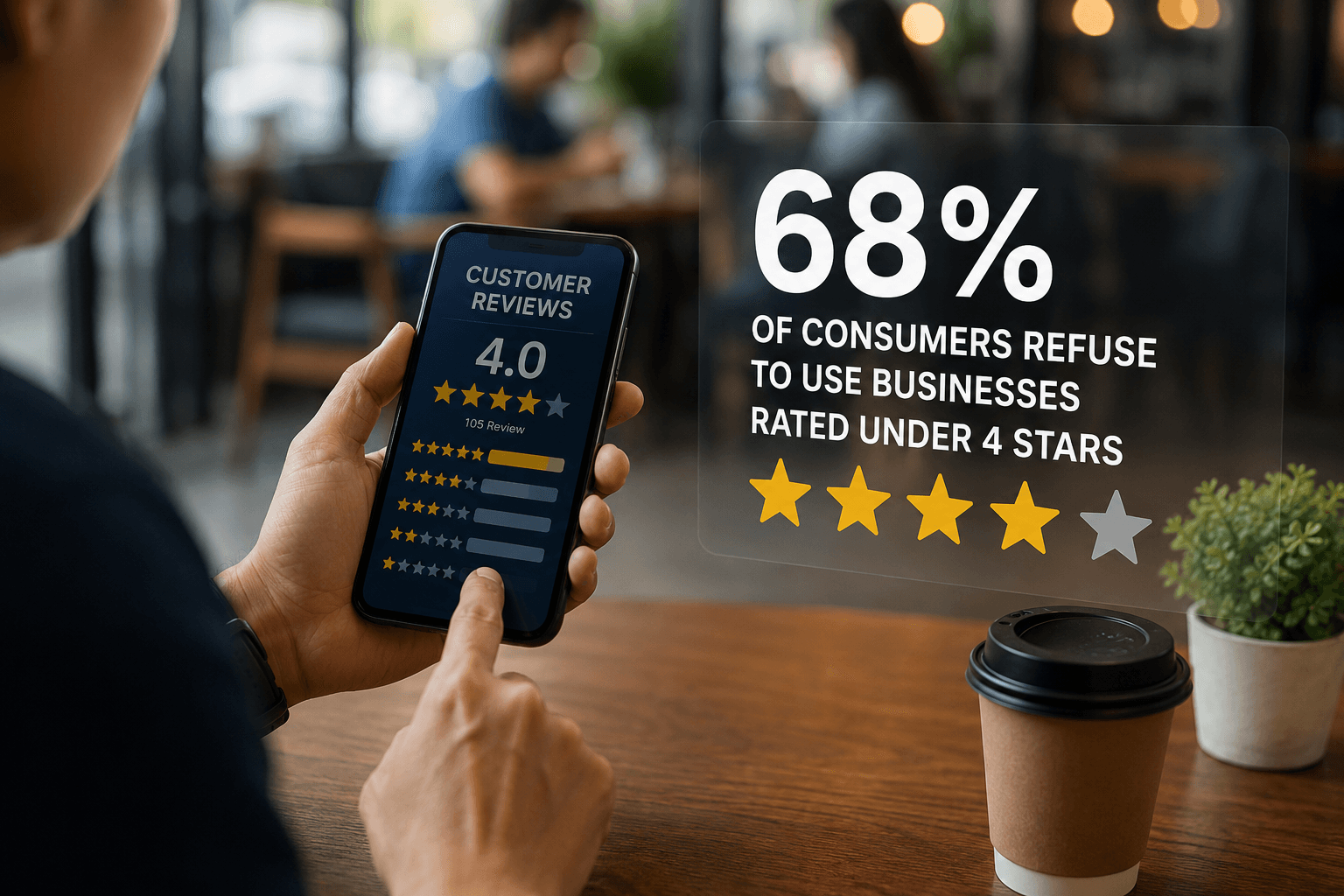
Here's a number that should worry any business owner who hasn't looked at their review metrics in six months: 68% of consumers now refuse to use a business rated under 4 stars.
Not 4.5. Not 4.2. Four. Zero.
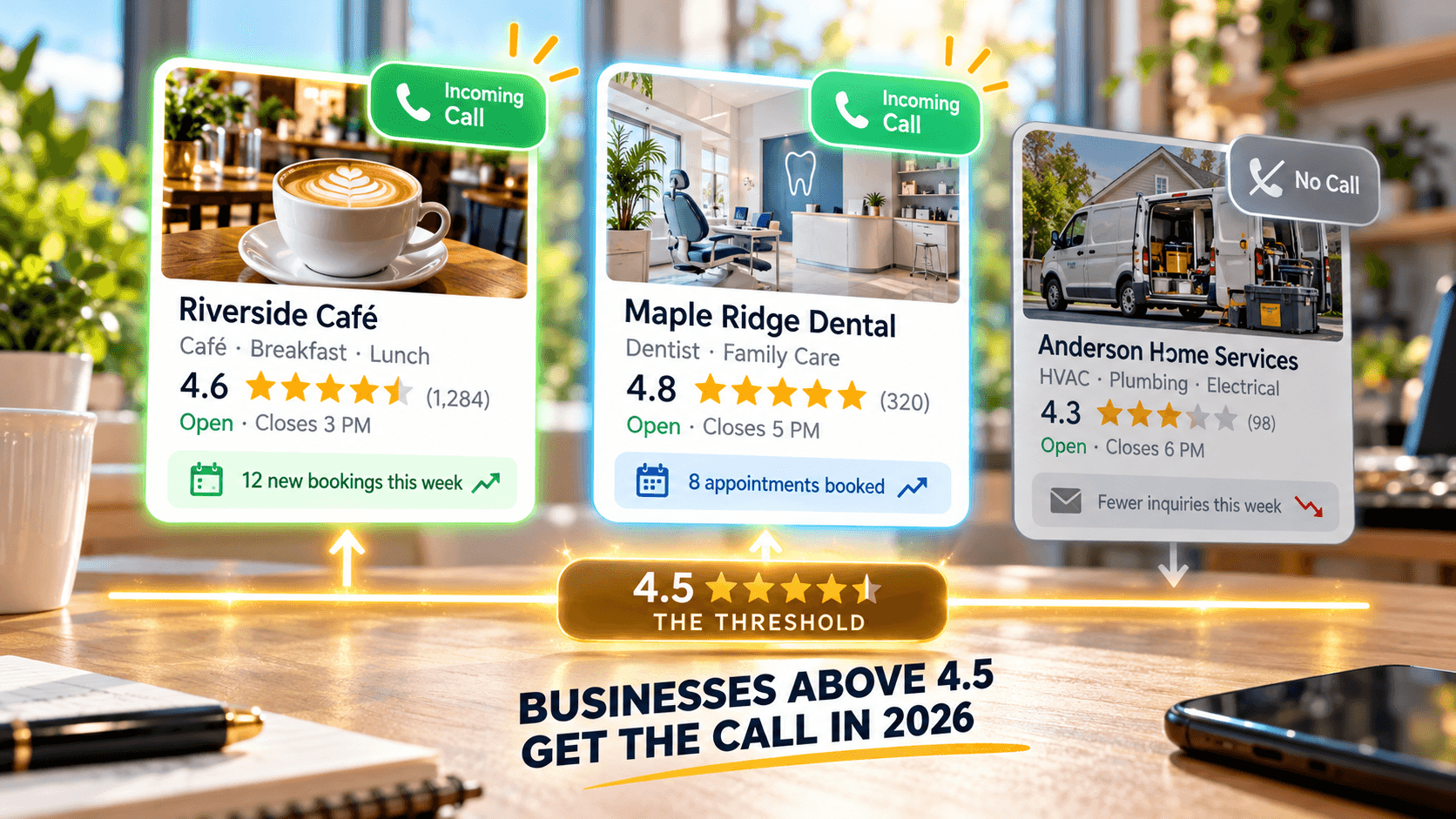
That's the headline finding from BrightLocal's 2026 consumer survey, and it represents a dramatic ratcheting-up of what customers expect when they search for a service provider, browse Google Maps, or ask a voice assistant for a recommendation. For local businesses — the restaurants, clinics, salons, and retailers that live and die by nearby search results — this isn't a trend. It's a gate. Below that line, most customers aren't even considering you.
The data comes at a moment when reputation management has quietly become one of the most consequential functions in local business strategy. Let's unpack what's happening, why it matters, and what the businesses doing this well are actually doing.
The Shift: Reviews as a Minimum Viable Product
For most of the last decade, a review presence was a nice-to-have. A few dozen reviews on Google, a handful on Yelp, maybe some on industry-specific sites, and you were fine. In 2026, that's not the case. The consumer has effectively turned reviews into a minimum viable product — a baseline threshold your business has to clear before they'll even look at your menu, your services, or your pricing.
The BrightLocal numbers tell the story clearly:
That means the business with a 3.8-star average on Google isn't getting a warning shot. They're getting ghosted.
Three Trends Reshaping Reputation Strategy in 2026
Beyond the star-rating threshold, reputation management as a discipline has evolved in three specific directions this year. Businesses that understand these shifts will pull ahead of competitors still treating reviews as a passive, after-the-sale afterthought.
1. AI-Assisted Review Response Is Now Standard
Over 80% of businesses are now using AI-driven tools to monitor, draft, and sometimes auto-publish review responses. Platforms like Birdeye, Semrush, and Reputation.com have made AI-assisted review response a core feature — not an add-on. The speed advantage is the point: businesses that respond to reviews within 24 hours see measurably higher conversion from search than businesses that take a week.
But there's a caveat. Consumers are also getting better at detecting when a response is obviously AI-written. The businesses winning this aren't the ones auto-posting templated thank-yous. They're the ones using AI as a first-draft tool and then adding a human touch — a specific reference to the customer's experience, a genuine apology when warranted, a personalized follow-up.
2. Authenticity Is Now a Regulatory Requirement
The FTC's 2023 fake-review rule has teeth now, and enforcement has picked up meaningfully through 2025 and 2026. Paying for reviews, incentivizing positive reviews without disclosure, or posting reviews about a competitor under a false identity — these carry real liability. For local businesses, the practical impact is a forced shift toward organic review generation: asking real customers for honest feedback, making the process easy, and never manipulating what they write.
The businesses adapting best are the ones who've made review collection a natural part of the customer journey — an automated email two days after service, a QR code at pickup, a prompt in the follow-up text. The ask is consistent, the response is low-friction, and the content is genuinely earned.
3. Reputation Now Extends Far Beyond Google Maps
Five years ago, "online reputation" meant Google and Yelp. In 2026, the picture is much more complex. AI-powered search tools — ChatGPT, Gemini, Perplexity — are now a significant source of how consumers discover local businesses. When someone asks ChatGPT for "the best dentist in Kingston, NY" or "a good HVAC company near New Paltz," those AI tools are pulling from review sites, social mentions, and web content to construct recommendations.
Your reputation isn't just your Google rating anymore. It's what every AI system in the country says about you when someone asks. That requires a broader strategy: maintaining consistent reviews across Google, Yelp, Facebook, industry-specific sites; keeping your website content fresh and crawlable; and making sure your public presence is coherent enough that AI models can accurately represent you.
The Local Business Playbook: What to Do This Month
Audit Your Current Rating
Start by knowing where you stand. Search for your business on Google and check your star rating. Search for your business on Yelp. Check Facebook. Note the average across each platform — and how many reviews you have on each. If your average across any platform is below 4.0, that's an urgent priority.
Make the Ask Systematic
Most local businesses that struggle with reviews aren't doing bad work. They're just not asking effectively. Build a simple system: after every completed service or every third visit, send a follow-up message that includes a direct link to leave a review. Make it frictionless. The best-performing businesses ask within 48 hours of the customer's last interaction.
Respond to Every Review
Negative reviews included — and actually, especially the negative reviews. A thoughtful, professional response to a 2-star review signals to every prospective customer reading it that you take feedback seriously. An angry or dismissive response signals the opposite. And no response at all signals you don't care.
Spread Your Presence Across Multiple Sites
If 90% of your reviews live on Google and you have nothing on Yelp, Facebook, or your industry's specific platforms, you're leaving the door open for AI-powered tools to misunderstand your business. Build a review presence on at least three platforms. Consistency matters more than volume on any single site.
The Bottom Line for Local Businesses
Reputation management in 2026 isn't about gaming a system or paying for visibility. It's about building a consistent, honest record of customer satisfaction and making sure that record shows up where customers — and AI systems — are looking.
The 4-star baseline isn't a suggestion. It's the floor. And for the businesses still sleeping on their review profiles, that floor is now the difference between being discovered and being invisible.
The good news? The fix is straightforward. Ask. Respond. Spread out. Do it consistently. The businesses doing this right aren't spending more money than their competitors — they're just spending their attention in the right places. |


41 Comments
Join the conversation
just looked up my shop and my yelp page hasnt been updated in two years. this article is embarrassing me into action
the FTC enforcement piece is something more people need to know about. i still see businesses in my area clearly buying reviews
Rachel_BizOwnerTotally. You can usually spot the bought ones too — all five stars, posted within the same week, super generic comments. The FTC really should be making more noise about it so people know there are actual consequences now.
my pizza place has 4.4 stars and i never respond to reviews. gonna start doing that. seems like low hanging fruit
the point about consistency over volume on any single site is something most small business owners miss completely
It's one of the most underappreciated points in the whole piece — a thinner but consistent multi-platform presence gives AI-powered discovery tools a much more accurate picture of your business than a single dominant profile.
been putting off a full review audit forever. going to do it tonight after reading this
That's exactly the right first step — knowing where you stand across each platform is the only way to know which gaps are urgent and which are just maintenance.
the 48 hour window for asking for a review is a detail i didnt know. been waiting like a week and probably losing the moment
not sure i fully buy the chatgpt recommending local businesses thing yet. how many people actually use it that way
i manage a small boutique and we have zero reviews on yelp. this is my sign to fix that this month
the ghosted line made me laugh but also feel bad. thats exactly what happens. people just move on without saying a word
GregOExactly, that's what makes it so brutal for business owners. No angry email, no complaint, just... silence. You never even get the chance to fix whatever went wrong.
"Ghosted" felt like the honest word for it — the unsettling reality is that dissatisfied customers rarely tell you, they just silently choose someone with a better rating instead.
need an automated system for this badly. doing it manually just never happens consistently
That's exactly why automation is worth the setup time — a well-timed follow-up text or email 48 hours after service does the consistent asking that almost never happens reliably by hand.
the AI written responses thing is so obvious when you see it. just say thanks for coming in, we appreciate you or something real. dont copy paste robot text
You've nailed the nuance we tried to highlight — the businesses winning at AI-assisted responses are using it as a first draft, not a finished product, and that human specificity is exactly what makes the difference.
i work at a dental office and we started asking for reviews after every appointment about a year ago. went from 4.1 to 4.6. it really does work
That's a perfect real-world illustration of exactly what we're describing — a half-point jump in just a year is significant, and 4.6 puts you well clear of the threshold that nearly a third of consumers now require.
the tip about spreading across multiple platforms not just google is underrated advice. yelp and facebook reviews are basically abandoned for most local shops around here
93% of people say reviews influence their decisions. i mean yes obviously but seeing that number is still a gut punch
DebraHollisRight? Like you kind of knew it intellectually but seeing 93% written out makes it feel very real. Basically everyone is checking before they spend a dime.
as an HVAC guy the mention of HVAC companies near New Paltz got my attention lol. need to get on this
the part about responding to negative reviews is so important. i watched a local restaurant owner go off on a 2 star review once and it was a disaster for them
Maria G.I remember that! The owner kept arguing back and forth in the comments for like a week. By the end it had way more views than the original review and none of it was good.
honestly still skeptical that people really wont look at a business under 4 stars. seems a little extreme
RonaldBI thought the same thing until I caught myself skipping past a 3.7 rated place last week without even thinking about it. It really does happen automatically at this point.
been using birdeye for about 6 months and the review response speed alone has made a noticeable difference. worth looking into
3 out of 10 people want 4.5 minimum?? that bar keeps getting higher every year
jimbo_localAnd it'll probably be higher next year too. People have more options and less patience. The threshold just keeps creeping up.
It really does keep moving — and the BrightLocal data suggests that trend isn't slowing down, which is why building strong review habits now matters more than waiting to react later.
the QR code at pickup idea is so simple i cant believe i havent done it yet. going to set that up this week
the fake review crackdown is real. a competitor near us got hit last year. not worth the risk at all
my salon has been at 4.1 forever and i never really worked at it. reading this makes me think i should be pushing harder for reviews after appointments
Sandra K.4.1 is honestly a solid foundation to build from. Even just a simple text after the appointment asking for a review can move the needle pretty fast. A stylist I know went from 4.1 to 4.6 in a few months just by being consistent about asking.
A salon is actually one of the best environments for this — repeat visits, personal relationships, and a natural moment at checkout to make a low-friction ask make the whole system easier to build.
need that automated email system they mentioned. anyone know a good tool for setting that up without spending a fortune
the part about AI search tools recommending businesses is wild. never thought about ChatGPT being the thing that sends or doesn't send customers my way
we just checked our google rating and we're at 3.9 stars. didn't realize how much that one decimal point was costing us
Mike R.Same thing happened to us! We were at 3.8 and had no idea. Once we started actually asking customers to leave reviews we got to 4.2 in about two months. That one number really does make a difference.