
The Real Cost of Ignoring Reviews: What 2026 Data Tells Us |
Businesses that don't respond to reviews lose 9% in revenue — and the gap is widening as consumers demand engagement |
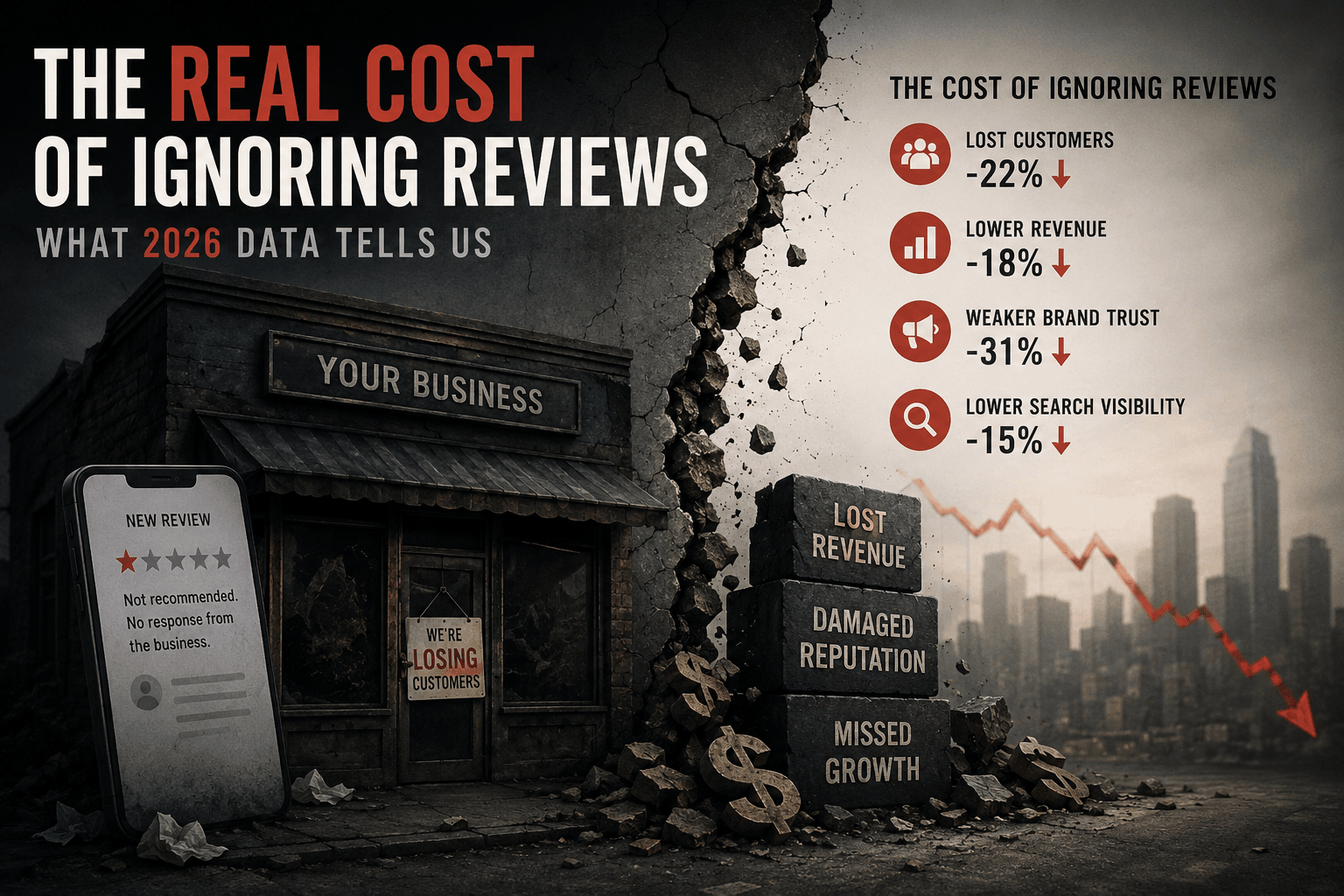
There's a persistent myth in small business that reviews are just something that happen to you — that your job is to do good work and let the reviews take care of themselves. But the 2026 data tells a different story: businesses that actively engage with their reviews outperform those that don't by a measurable, significant margin.
The 9 Percent Gap
Research from Harvard Business Review found that restaurants responding to all reviews saw a 6.5 percent revenue increase over six months, while those responding to none saw no change. But here's what's interesting: the benefit isn't linear. Businesses responding to just 30 or 50 percent of reviews see minimal improvement. The real gains come from businesses hitting 90 percent or higher response rates.
More recent data from ReviewTrackers shows the gap has widened to 9 percent. Businesses that respond to reviews consistently earn 9 percent more revenue than those that don't. That's not a rounding error — that's the difference between a good year and a great year.
Why Response Rate Matters More Than Response Quality
Most business owners worry about what to say in their responses. They spend time crafting the perfect reply, worrying about tone and wording. But the data suggests that whether you respond matters more than how eloquently you respond.
A simple "Thanks for the feedback, we appreciate you taking the time" carries more weight than a perfectly worded response that only appears on 40 percent of your reviews. Consumers are looking for evidence that you're paying attention. Response rate is that evidence.
The Compounding Effect
Response rates compound over time. When you consistently respond to reviews, you create an expectation. Customers start to notice that you're engaged, and they're more likely to leave reviews in the first place because they know you'll see them.
That creates a virtuous cycle. Higher response rates lead to more reviews, which leads to more social proof, which leads to more customers, which leads to more revenue. Businesses that break the cycle by ignoring reviews find themselves stuck in the opposite pattern — fewer reviews, less visibility, fewer customers.
What About Negative Reviews?
This is where most business owners get nervous. They worry that responding to negative reviews will make things worse or draw more attention to complaints. But the research shows the opposite: businesses that respond professionally to negative reviews actually see better outcomes than those that ignore them.
A thoughtful response to a one-star review shows other potential customers that you care about fixing problems. It demonstrates accountability. And in many cases, the customer who left the negative review will update or remove it after seeing that you've taken their feedback seriously.
The Practical Reality
Responding to 90 percent of your reviews doesn't mean writing essays. Most responses can be two or three sentences. Thank the customer, acknowledge specific details they mentioned, and move on. The goal isn't to win awards for customer service writing — it's to show that you're present and engaged.
The businesses that struggle with this usually don't have a quality problem — they have a systems problem. They're trying to respond to reviews ad hoc, whenever they remember to check. The solution is building a process: designate someone to check reviews daily, set a goal of responding within 24 hours, and track your response rate as a metric.
The Bottom Line
Your review response rate is a leading indicator of your online reputation health. If you're responding to less than 70 percent of reviews, you're leaving money on the table. If you're below 50 percent, you're probably losing customers to competitors who respond more consistently.
The good news is that this is one of the easiest reputation improvements to make. You don't need new software, additional staff, or a big budget. You just need a commitment to showing up in the conversations your customers are already having about your business.
Stay informed about reputation management strategies that drive real business results. Subscribe to ReputationShowcase.com for weekly insights. |



0 Comments
Join the conversation
Be the first to comment
Share your thoughts above.